VEED Subtitle API vs CapzAi in 2026
A practical comparison of VEED's new Subtitle API and CapzAi for styled captions, localization, export workflows, and creator-speed publishing.
VEED just made a clear market move: captions are no longer only an editor feature. They are infrastructure.
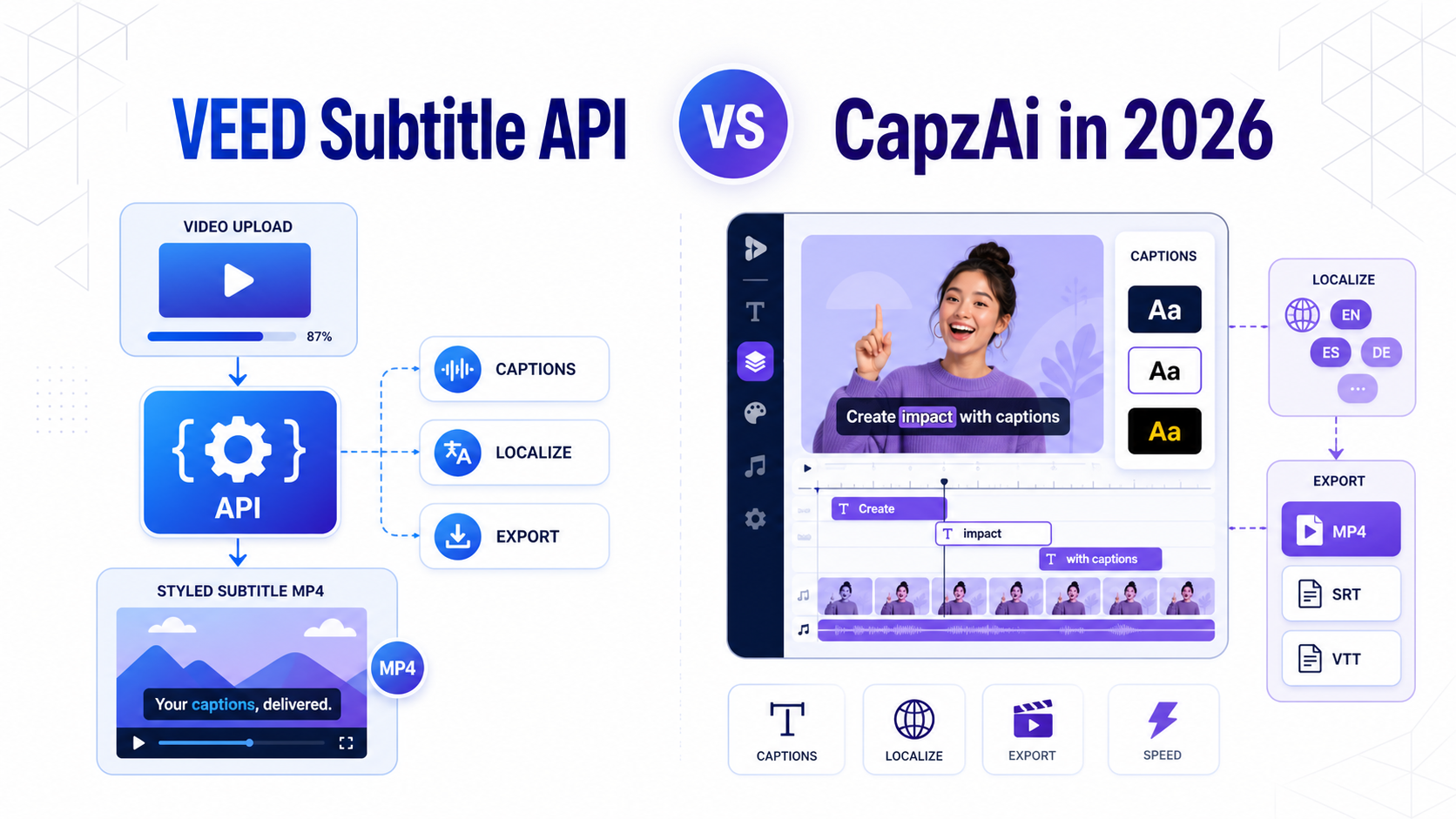
In its launch post for the VEED Subtitle API, VEED says a developer can submit a video URL, choose a preset, and get back a styled MP4 with burned-in subtitles in a single API flow. VEED also positions the product as more than speech-to-text, emphasizing transcription, styling, rendering, and safe-zone-ready output.
That matters for CapzAi buyers because the category is splitting into two lanes:
- API-first subtitle rendering for products and internal automation.
- Creator-first subtitle editing for teams shipping short-form clips every day.
If you are deciding between VEED Subtitle API and CapzAi in 2026, the real question is not which one is "better." The question is which workflow removes more friction for your team.
The Short Answer
Choose VEED Subtitle API if you are building subtitle generation into your own software, client portal, internal media pipeline, or batch-processing system.
Choose CapzAi if you need a production tool for clipping, styling, reviewing, translating, dubbing, and exporting short-form content without building the workflow yourself.
They overlap at the caption layer, but they solve different operational problems.
Why VEED's API Launch Matters
VEED's launch is important because it confirms a broader trend: premium subtitles are becoming programmable.
In the official release, VEED says the API returns a styled MP4 in one call, supports preset-based formatting, and starts at $0.10 per minute through fal.ai. VEED also claims safe-zone-aware rendering and positions the product as an end-to-end alternative to stitching together separate speech-to-text, timestamp alignment, styling, and render infrastructure.
That is a real shift. A year ago, many teams still treated captions as a manual editor step. In 2026, caption rendering is increasingly being treated like any other media service endpoint.
For product teams, that is attractive. For working creators, it can still be the wrong abstraction.
VEED Subtitle API vs CapzAi at a Glance
| Category | VEED Subtitle API | CapzAi |
|---|---|---|
| Primary buyer | Developers, platforms, internal tools teams | Creators, agencies, editors, social teams |
| Core workflow | API call returns styled MP4 | Upload, clip, style, localize, export |
| Interface | Build your own interface or automation layer | Ready-to-use editor and AI agent |
| Subtitle styling | Presets via API | Presets plus direct visual editing |
| Translation | Bring your own translated SRT | Built-in subtitle translation workflow |
| Dubbing | Not the point of the product | Available in CapzAi workflows |
| AI clipping | Not the main use case | Built into the broader repurposing flow |
| Review loop | External to the API | In-product preview and iteration |
| Best for | Media infrastructure | Fast social production |
Where VEED Subtitle API Wins
VEED has the edge when the subtitle system needs to disappear into your product.
Examples:
- You run a UGC marketplace and want every submitted video captioned automatically.
- You operate an internal publishing pipeline and need subtitle rendering in the background.
- You want a developer to trigger caption jobs after upload without training staff on an editor.
- You need to process large volumes of videos the same way every time.
This is exactly the use case VEED describes. The launch article explicitly separates pure speech-to-text APIs from subtitle APIs that return styled video, and VEED is clearly targeting the second category.
If your team already thinks in queues, webhooks, workers, and asset URLs, an API can be cleaner than asking people to open a browser editor.
Where CapzAi Wins
CapzAi wins when the bottleneck is not subtitle rendering alone. It wins when the actual problem is turning source footage into publishable short-form content.
That includes:
- Finding the right clips from a long recording.
- Applying a caption preset that matches the creator's style.
- Fixing wording, timing, and emphasis after transcription.
- Translating subtitles into French, Arabic, or Darija.
- Reviewing RTL layout and line breaks before export.
- Generating a final MP4 and, when needed, an
.asssubtitle file for pro editors.
That is why comparing a subtitle API to CapzAi can be misleading. CapzAi is not only a subtitle renderer. It is a workflow product for short-form repurposing.
If your editor or social manager is still making judgment calls on hooks, pacing, safe zones, language quality, and output format, giving them an API endpoint does not remove the hard part.
Translation Is the Real Separation
VEED's own documentation is direct here. In the launch article, VEED says the Subtitle API transcribes and styles subtitles, but it does not translate them unless you provide a pre-translated subtitle file.
That means a multilingual team still needs to solve:
- subtitle translation
- QA for meaning and tone
- right-to-left rendering checks
- line-break quality
- voice and dubbing decisions
CapzAi is much closer to that real-world need. For teams publishing into MENA, Europe, or bilingual audiences, subtitle generation alone is only the first 60 percent of the job.
Related reading: best AI caption tools for Arabic and MENA creators and how to translate video subtitles into 5 languages.
API Economics vs Operator Economics
On paper, APIs often look cheaper because the visible unit is usage.
VEED lists starting pricing at $0.10 per minute. That can be attractive if you already have engineering support and you know exactly what the product should do after the render job finishes.
But the real cost question is broader:
- Who builds the upload flow?
- Who handles retries and failed renders?
- Who manages style selection logic?
- Who reviews subtitle quality?
- Who solves translation and localization?
- Who gives non-technical team members a way to make edits?
If you need to build those layers anyway, the "cheap API" story changes quickly.
CapzAi flips the math. Instead of minimizing infrastructure cost, it minimizes operator time. For many creator teams, that is the more important number.
When the Better Stack Is Both
For some teams, the answer is not VEED or CapzAi. It is VEED and CapzAi, but at different layers.
An example:
- A platform uses an API to guarantee every customer-uploaded asset gets baseline captions.
- The marketing team takes high-potential videos into CapzAi.
- In CapzAi, they refine the clip, restyle captions, translate it, and produce market-specific exports.
That hybrid model is becoming more common across AI video tooling. The repetitive layer becomes programmable. The performance layer stays editable.
How CapzAi Fits the 2026 Market
VEED's API launch lines up with a larger pattern across the category. Native platforms and creative tools are pushing deeper into automation:
- TikTok introduced Smart Split, an AI tool for turning longer videos into shorter clips inside TikTok's creator stack.
- Runway launched Aleph 2.0 and Edit Studio on May 21, 2026 to help teams transform existing footage with more precise video edits.
- Adobe introduced Quick Cut in Firefly, positioning AI as a first-cut layer before detailed editing.
The pattern is straightforward: every major player is trying to remove one production bottleneck.
CapzAi's advantage is that it stays close to the social-video finishing layer where creators still lose the most time: clip selection, captions, layout, localization, and export.
Who Should Pick Which Tool
Choose VEED Subtitle API if:
- you have developers
- you want caption rendering inside your own product
- your output is standardized
- you do not need built-in translation or review workflows
Choose CapzAi if:
- you publish short-form content weekly or daily
- a creator or editor needs to review the output before posting
- you localize into multiple languages
- you want captions, clipping, and export in one workflow
- you do not want to build infrastructure to get styled subtitles
Final Verdict
VEED Subtitle API is a strong signal that caption rendering is becoming an infrastructure layer. For software teams, that is useful.
For most creators, agencies, and social operators, it is still not the whole job.
If you need programmable subtitle rendering inside a product, VEED's API is relevant. If you need a faster path from source footage to captioned, localized, publish-ready short-form video, CapzAi is the better fit.
That is the simplest way to think about it: VEED helps you build subtitle automation. CapzAi helps you ship content.
If your workflow starts with a backlog of videos and ends with Reels, Shorts, TikToks, or multilingual social assets, that difference is the one that matters.
Related articles
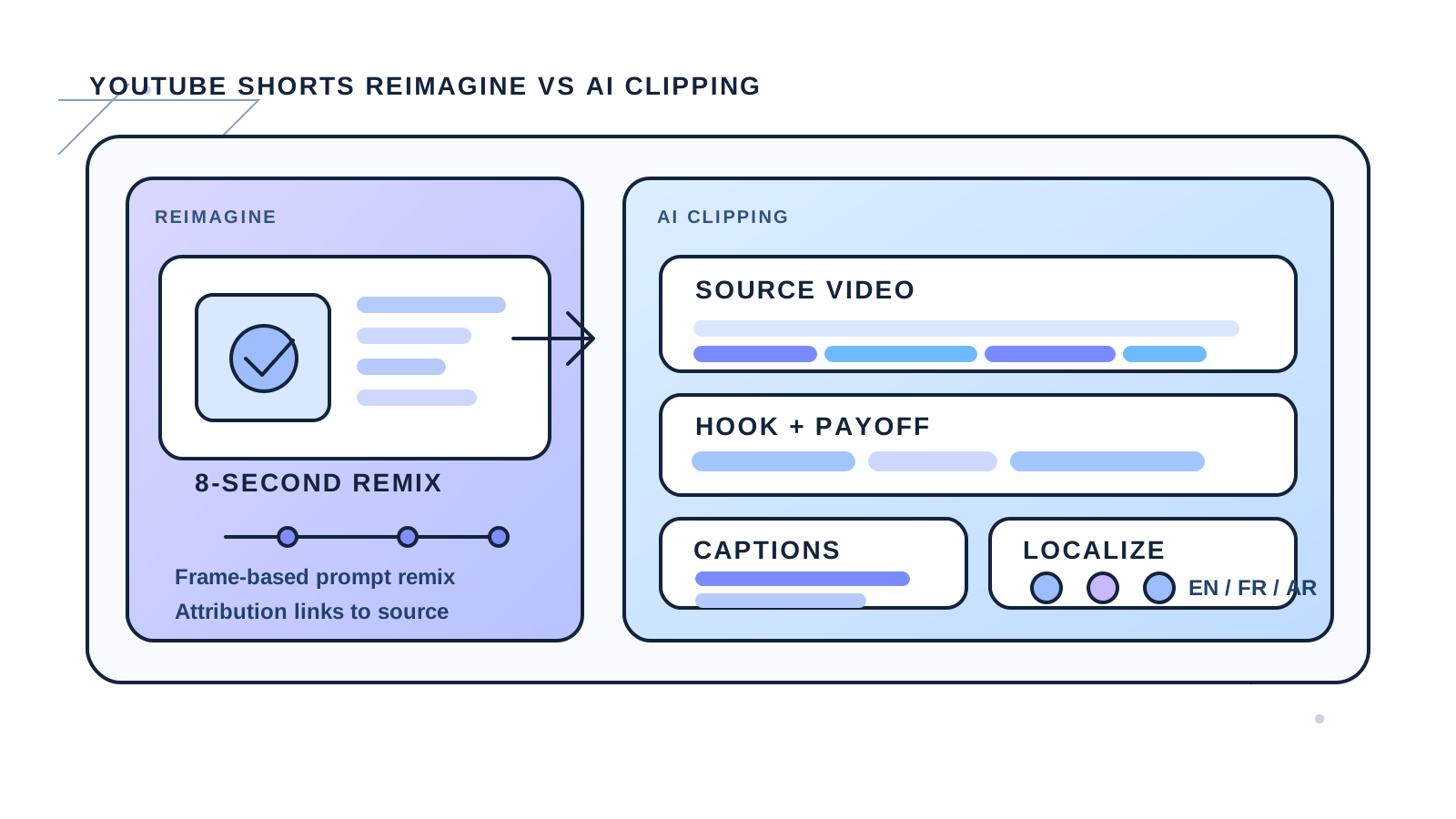
YouTube Shorts Reimagine vs AI Clipping in 2026
YouTube's new Reimagine remix tool opens a fresh creation path for Shorts, but it does not replace clipping, captions, or localization workflows.
Read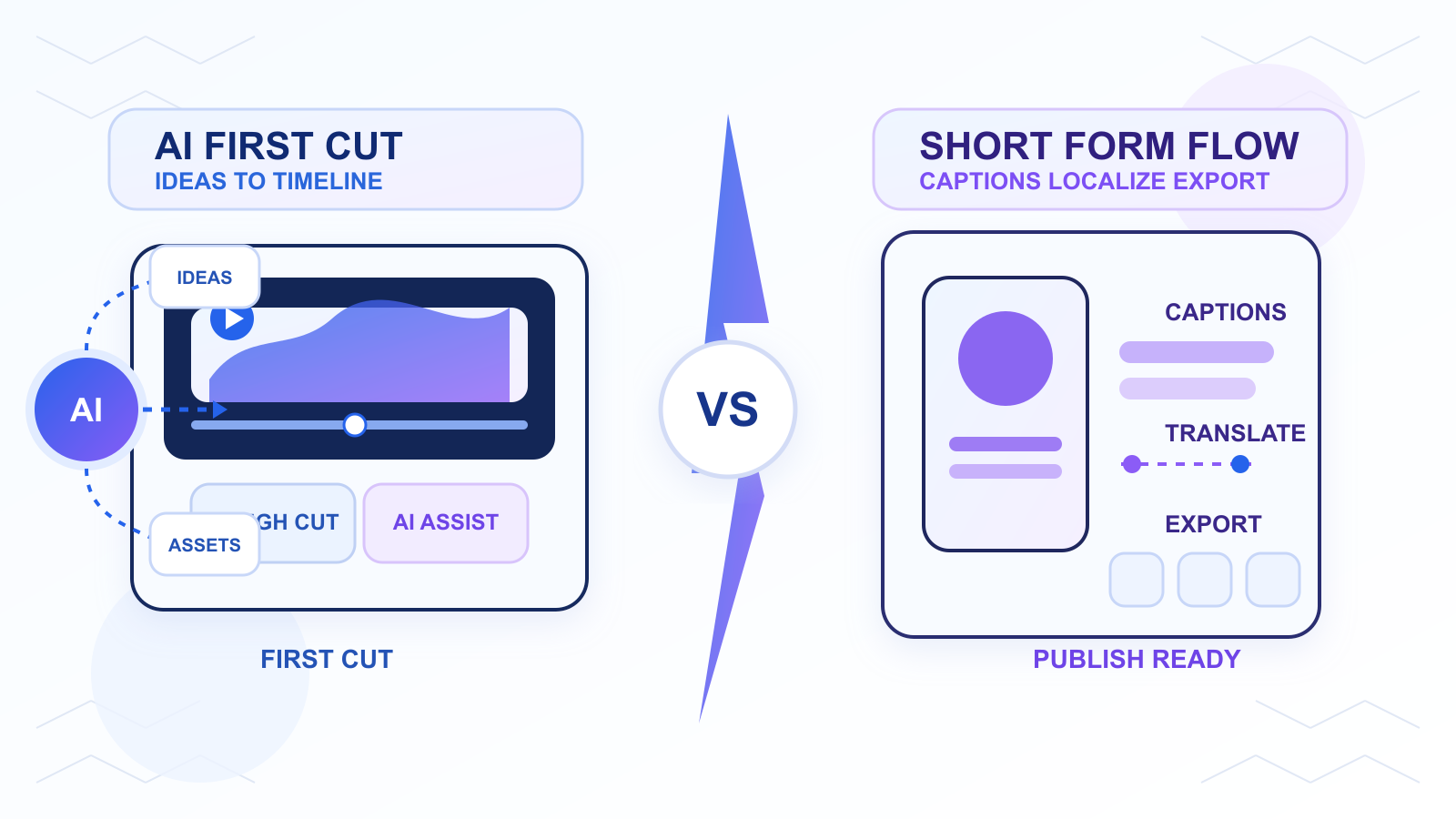
Adobe Firefly Video Editor vs CapzAi in 2026
Adobe is pushing agentic video creation and first-cut editing inside Firefly, but short-form teams still need a faster system for clipping, captions, localization, and export.
Read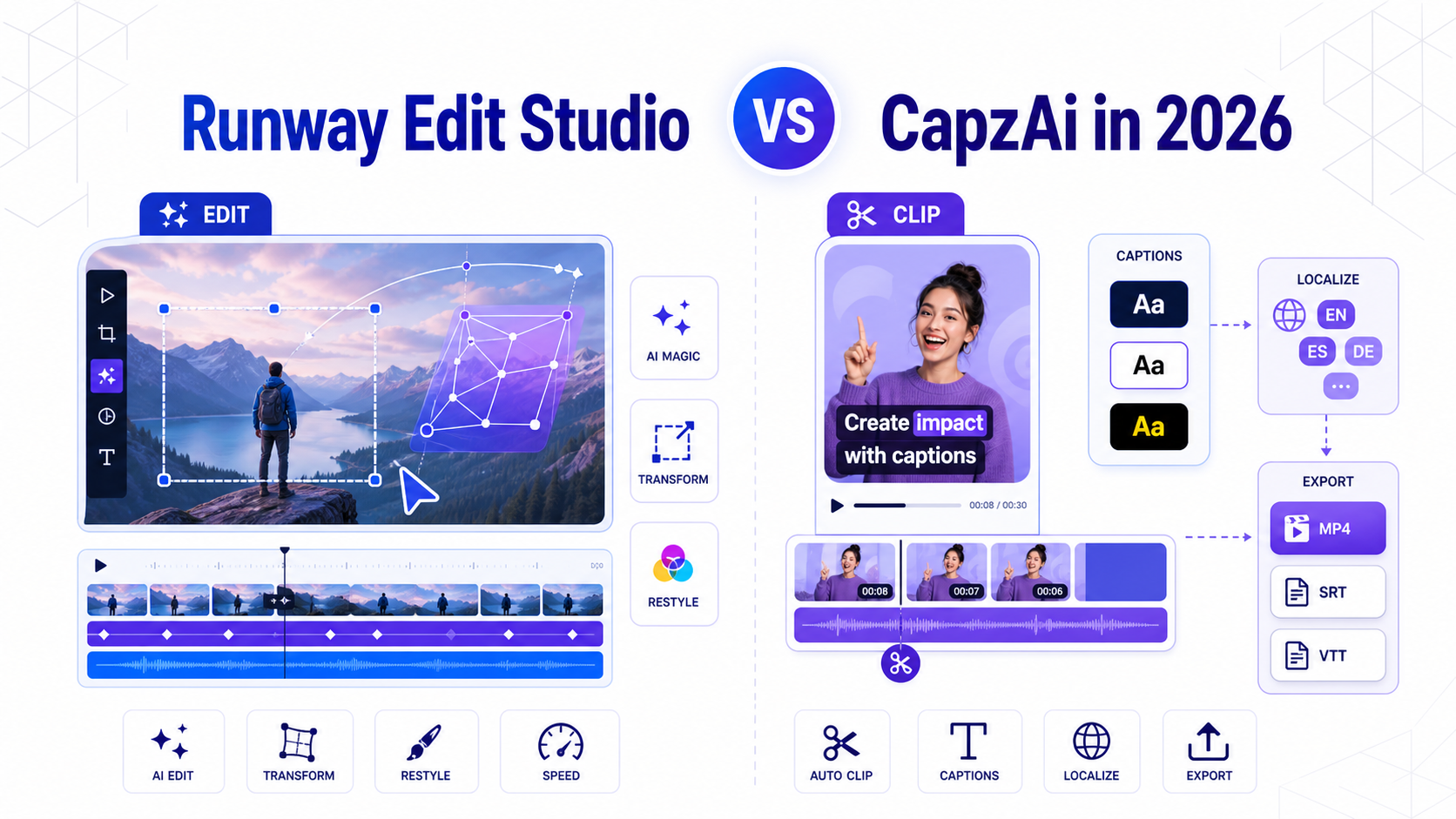
Runway Edit Studio vs CapzAi in 2026
How Runway's new Aleph 2.0 editing workflow compares with CapzAi for short-form clipping, captions, localization, and creator production speed.
Read