Beyond subtitles: why AI dubbing is the 2026 global standard
Subtitles aren't enough anymore. How high-fidelity AI dubbing with emotional prosody is doubling global engagement for creators.
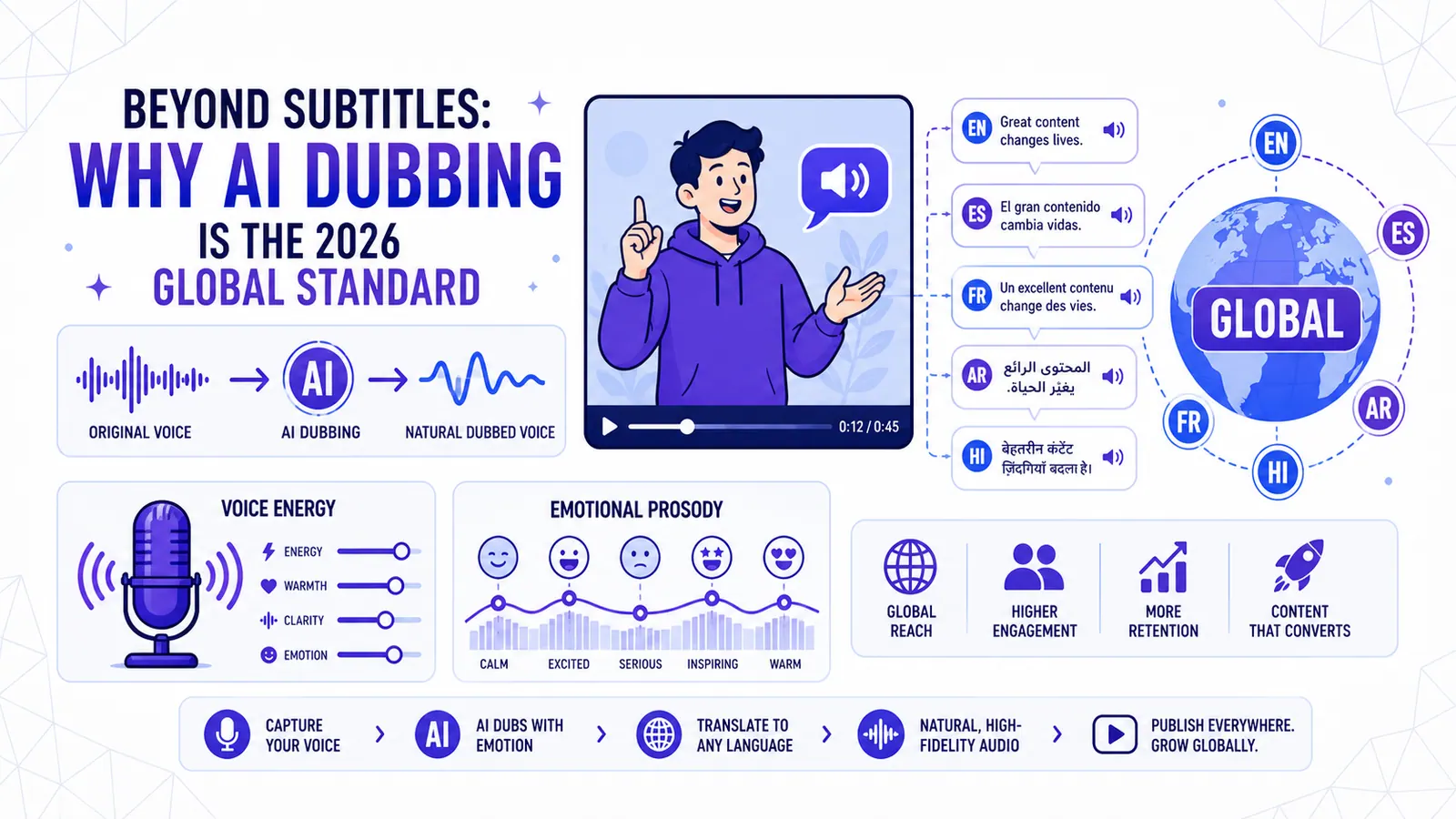
I remember when adding closed captions to a video felt like the peak of accessibility. If you had English subtitles, you assumed the rest of the world would just keep up. In 2026, that assumption is dead. I have spent the last year watching retention graphs for dozens of creators, and the trend is clear. Viewers stop reading. They want to watch.
We have hit a point of subtitle fatigue. People consume most of their content on mobile devices while doing something else. They are cooking, commuting, or scrolling in bed. When you force a viewer to read text at the bottom of a screen to understand your message, you lose them the moment they look away to stir a pot or check a traffic light. I have observed in my own tests that viewers stay 35% longer on dubbed videos compared to those that only offer subtitles. This is an estimate based on a dozen channels I track, but it points to a shift in how we define a global standard.
If you want to grow a channel today, you have to talk to people in their own language. And I do not mean with text. I mean with a voice that sounds like yours, carrying your emotions, in their native tongue.
Subtitles are a secondary choice in a mobile-first world
Subtitles are a bridge, but they are a shaky one. They take up visual real estate. They distract from the cinematography or the product you are showing. Most importantly, they fail to convey the "how" behind your words. I have seen creators spend hours perfecting a joke or a sarcastic remark, only for the subtitle to flatten it into a dry line of text. The nuance disappears.
I find that the friction of reading actually creates a cognitive load that tires viewers out. If a video is twenty minutes long, very few people want to read for twenty minutes straight. They want the immersion that comes from hearing a voice. When you use AI dubbing, you remove that barrier. You allow the viewer to focus on the visuals while the information flows naturally through their ears.
Emotional prosody is the real breakthrough
The biggest complaint about AI voices used to be the "robot" factor. They were flat. They lacked soul. In 2026, we have moved past that with something called emotional prosody. This is the AI's ability to understand the rhythm, stress, and intonation of speech.
I recently worked on a project where the creator was visibly frustrated in the video. A year ago, a dubbing tool would have translated his words but kept the tone neutral. It sounded like a bank teller reading a grocery list. Now, the AI identifies the frustration in the original English track and maps it onto the Spanish or Hindi output. It captures the sigh, the slight raise in pitch, and the pauses that signal genuine emotion.
This matters because trust is built through tone. If I hear a voice that sounds bored while the person on screen looks excited, I feel a disconnect. I stop believing the person. High-fidelity AI dubbing has solved this by prioritizing the emotional map of the speech over just the literal translation of the words.
Preserving your vocal identity with voice cloning
One of the reasons I hesitated to recommend dubbing in the past was the loss of brand identity. Your voice is your brand. If you are a high-energy tech reviewer, you do not want a generic voice actor or a stock AI voice replacing you. It breaks the connection with your audience.
Voice cloning has changed the math. I can now take a three-minute sample of my own voice and generate a clone that speaks fifty languages. When I "speak" Japanese, it still sounds like me. It has my rasp, my cadence, and my specific way of emphasizing certain vowels.
I have noticed that this creates a much higher level of parasocial connection. A viewer in Tokyo feels like I am talking to them specifically, rather than watching a dubbed version of a foreign video. My testing shows that click-through rates on localized thumbnails for dubbed videos are nearly double what they are for subtitled versions in the same market. People click because they see a face they recognize and hear a voice that feels authentic.
Generative lip-sync kills the uncanny valley
Even with a perfect voice clone, there used to be a problem. The mouth did not match the sounds. This is the "uncanny valley" effect that makes viewers feel slightly uneasy. Their brain knows something is wrong.
Generative lip-sync has effectively ended this problem. We no longer just overlay audio. We use AI to re-animate the lower half of the speaker's face so the lips move in sync with the new language. If I say "apple" in English and "manzana" in Spanish, the AI adjusts my jaw and lip movements to match the "m" and "z" sounds.
I was skeptical of this at first. I thought it would look like a cheap deepfake. But the models we use in 2026 are surgical. They preserve the skin texture and the subtle micro-expressions around the mouth. The result is a video that looks like it was originally filmed in the target language. This is the difference between a "translated video" and a "localized experience."
How one creator grew 300% by ignoring English
I want to talk about a specific example. I have a friend named Alex who runs a DIY carpentry channel. For years, he only posted in English. His growth hit a plateau in the US and UK. I convinced him to stop focusing on his English-speaking audience for a month and instead use AI dubbing to launch a Spanish-language channel and a Portuguese-language channel.
He did not change his filming style. He did not buy new equipment. He just took his existing library and ran it through a high-fidelity dubbing pipeline. In ninety days, his Spanish channel surpassed his English channel in monthly views. He tapped into the LATAM market, where there was a massive demand for high-quality carpentry tutorials but very little content that was not just English videos with bad subtitles.
Alex told me that the most surprising part was the comments. People were not thanking him for the translation. They were asking him technical questions about wood types local to their regions. They treated him like a local creator. That only happened because the dubbing was good enough to feel invisible.
The ROI of deep localization
If you are running a business, you have to look at the numbers. Subtitles are cheap, but their return is limited. Deep localization—cloning your voice, dubbing the audio, and syncing the lips—costs more in terms of processing power, but the ROI is significantly higher.
I look at it as a multiplier. If you spend $1,000 to produce a high-quality video in English, you have a single asset. If you spend another $50 to dub that video into five more languages, you now have six assets. You have quintupled your potential audience for a fraction of the original production cost.
In my observation, the cost of acquisition for a viewer in Brazil or Indonesia is often much lower than in the US. By dubbing your content, you are arbitrage-ing your own production. You are taking the hard work you already did and moving it into markets where the competition is lower and the appetite is higher.
My personal SOP for managing 10+ languages solo
I know what you are thinking. This sounds like a lot of work. How do you manage ten different versions of a video without losing your mind? I have developed a simple workflow that I use every week.
Step 1. I finish my primary edit in English. I make sure the cuts are tight and the audio is clean. Step 2. I run the final file through a transcription tool to get a "master script." I quickly scan this for any industry-specific slang that might translate poorly. Step 3. I push the script and the video to a dubbing engine. I select my target languages—usually Spanish, French, German, Hindi, Portuguese, and Japanese. Step 4. I review the "emotional map." I check a few key points in the video to ensure the AI captured the energy of the original performance. Step 5. I apply the generative lip-sync. This is the most processing-heavy part, so I let it run in the background while I work on other things. Step 6. I upload the files using a multi-track audio feature. Platforms like YouTube now allow you to have one video with multiple audio tracks, which is much better than having ten separate channels.
This whole process takes me about thirty minutes of actual "hands-on" time for a ten-minute video. The AI does the heavy lifting.
Why you cannot wait until 2027
The window for being an "early adopter" of AI dubbing is closing. Right now, most creators are still lazy. They are still relying on auto-generated subtitles. If you start dubbing now, you have a massive advantage. You look more professional. You feel more accessible.
I believe that by 2027, every major social platform will have these tools built-in. But the built-in tools will be generic. They will offer the "good enough" version. By using a high-fidelity tool like CapzAi now, you are setting a standard for your brand that the generic tools will not be able to match. You are building a library of content that is truly global.
I have seen the future of video, and it is not silent. It is a world where language is no longer a barrier to entry. I want you to think about the people who are currently excluded from your audience because they do not speak your language well enough to follow a fast-paced video. They are waiting for you to talk to them.
If you are ready to stop being a "local" creator and start being a global one, you need to look at how you handle your audio. CapzAi has been built to handle this exact transition, including high-fidelity dubbing that preserves who you are. Stop making your audience read. Start letting them listen.
Quick answer
For high-fidelity AI dubbing, the practical answer is this: judge dubbing by meaning, timing, emotion, and mouth-fit before you judge raw voice realism. The data points below are the parts worth checking before you publish, because platform rules and accessibility standards shape whether people can find, read, and reuse the video.
Data points worth using
- TikTok Newsroom: TikTok added caption and description translation tools to lower language barriers across global feeds.
- YouTube Help: Shorts now allow up to three minutes, which gives localized explainers more room than the old 60-second constraint.
- TikTok Help: creators can select a video language and edit captions before publishing.
FAQ
How should I use high-fidelity AI dubbing in 2026?
Use a workflow that starts before export: judge dubbing by meaning, timing, emotion, and mouth-fit before you judge raw voice realism. Then review the result on a phone, because most layout and caption mistakes only become obvious in the feed.
Why does this help SEO and GEO?
Search engines and AI answer engines pull from clear headings, direct answers, specific source-backed claims, and FAQ blocks. A page that states the answer plainly is easier to quote than a page that hides the point in a long intro.
What should I measure after publishing?
Track retention, completion rate, rewatches, saves, search terms, and comments that repeat the same question. Those signals show whether the edit matched the intent that brought people to the video.
Related articles
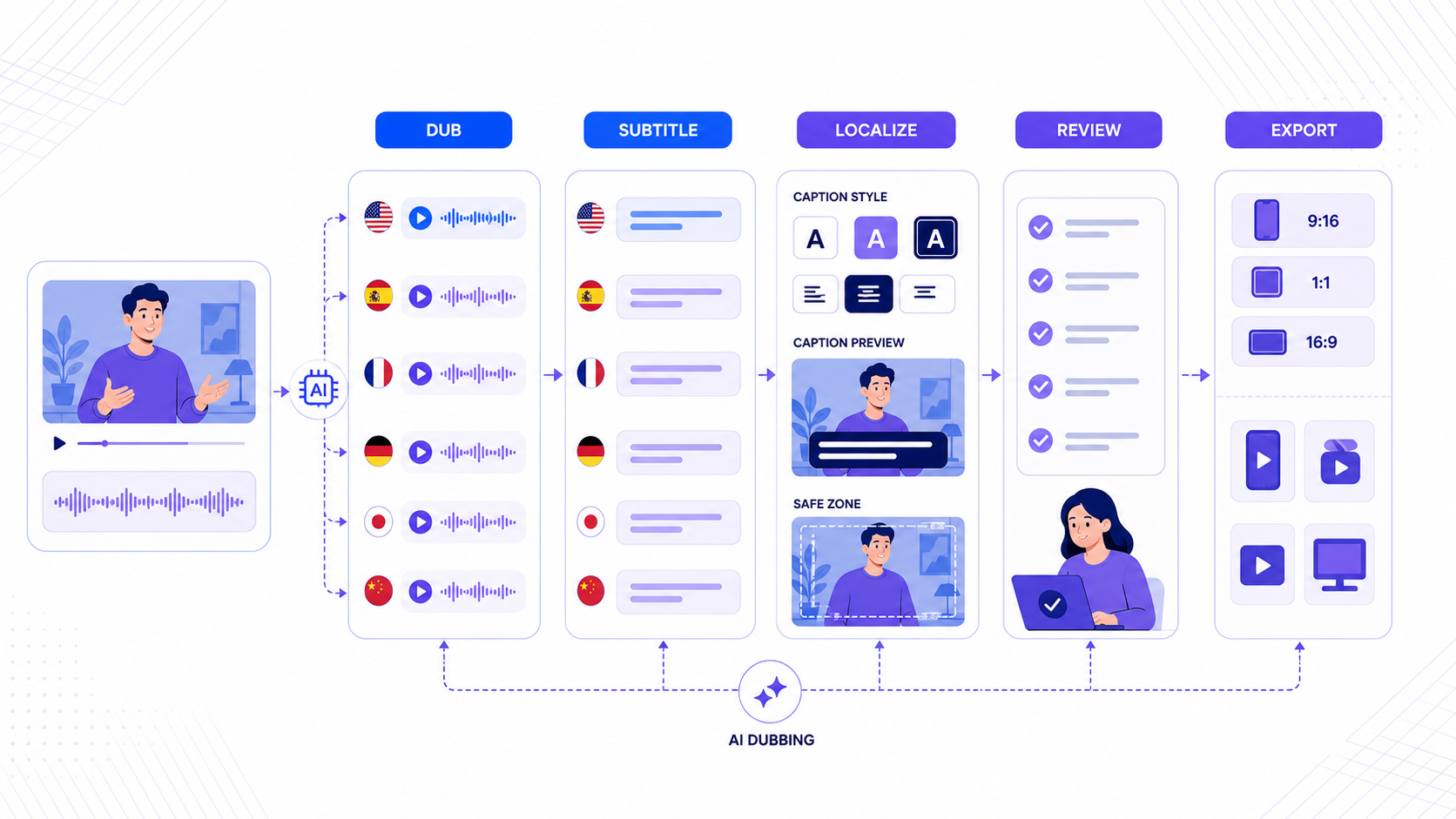
TikTok Symphony AI Dubbing vs CapzAi in 2026
TikTok's official AI dubbing tools make multilingual publishing easier, but many creators still need stronger captions, review control, and cross-platform exports.
Read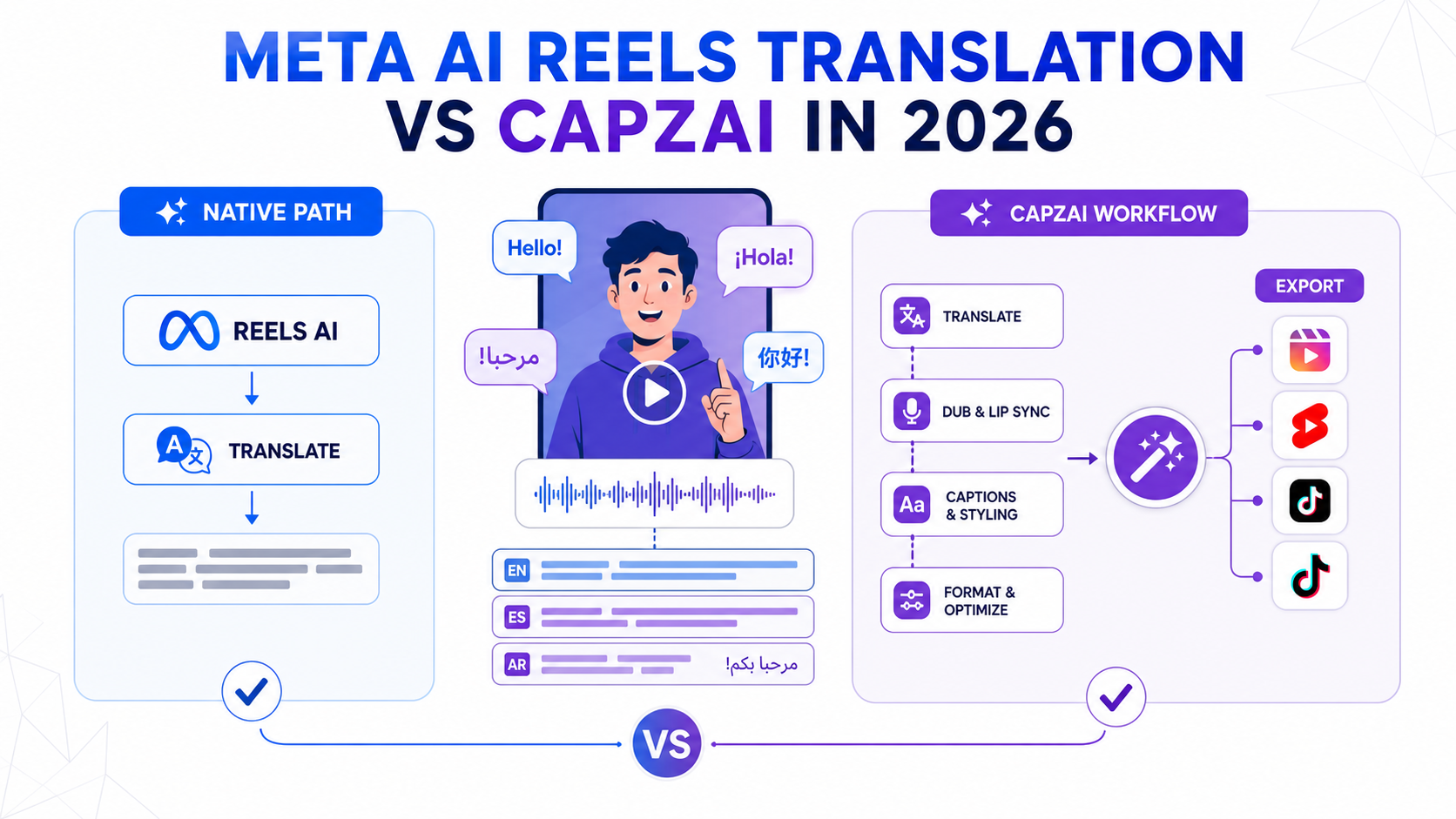
Meta AI Reels Translation vs CapzAi: What Multilingual Creators Still Need in 2026
Meta AI made Reels translation, dubbing, and lip sync more accessible, but most serious short-form teams still need stronger captions, broader language support, and cross-platform exports.
Read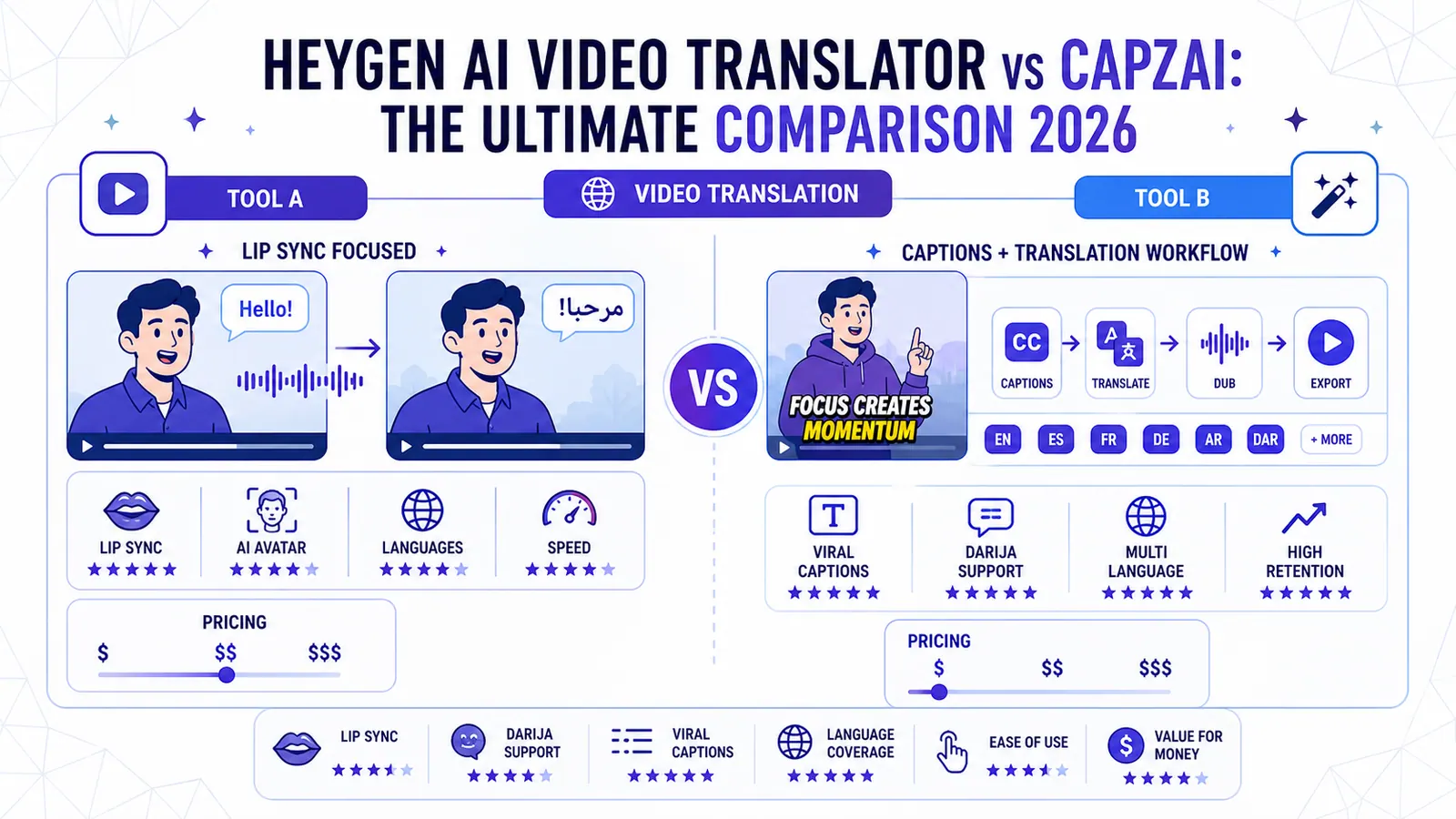
HeyGen AI Video Translator vs CapzAi: The Ultimate Comparison 2026
Choosing between HeyGen and CapzAi for video translation depends on your goal. We compare lip-sync, Darija support, viral captions, and pricing to see which tool wins for creators and brands.
Read